Written by the Planet team — we’ve been arranging wind-sport holidays for more than 25 years, and wingfoil trips for as long as the sport has existed. Updated September 2026.
Wing foiling is the newest of the wind-powered water sports: you stand on a board, hold an inflatable wing in your hands, and a hydrofoil under the board lifts you clear of the water as you gather speed, so you end up flying about a metre above the surface, almost silently. The first wings went on sale in 2019, the boom started in 2020, and at the world’s big wind venues it has already overtaken windsurfing in sheer numbers on the water. This guide explains what it actually is, how it compares to kitesurfing and windsurfing, and how — and where — to learn it.
What wing foiling actually is
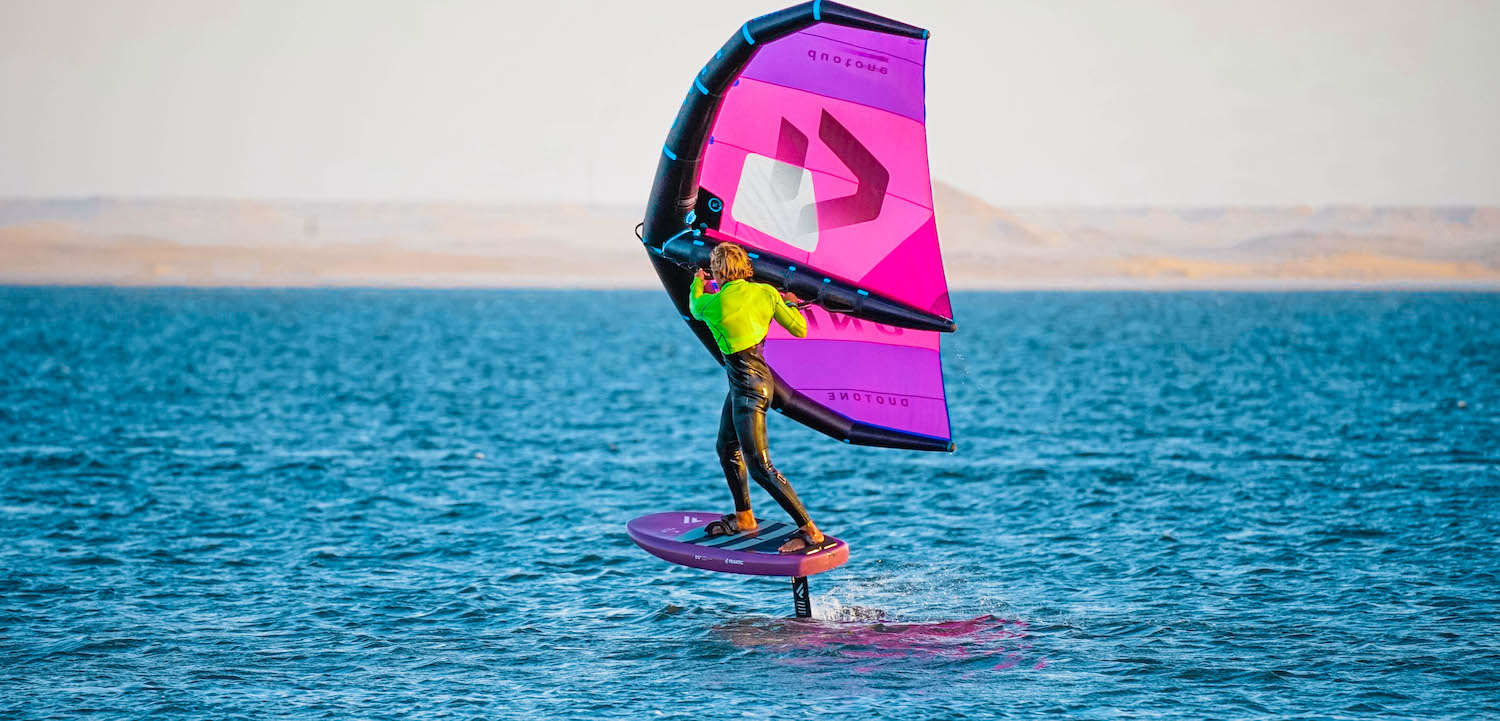
It’s a hybrid of the wind sports that came before it, with one big difference underneath. The power comes from a wing — an inflatable, hand-held sail with grip handles or a light boom. It isn’t attached to the board like a windsurf sail, and there are no lines like a kite: you simply hold it, angle it to the wind for power, and flag it out flat to switch the power off. Under your feet is a board, ridden with or without foot straps. And beneath the board is the part that defines the sport: a hydrofoil — a mast about 70 to 90 centimetres long with wings at the bottom, shaped exactly like an aircraft’s.
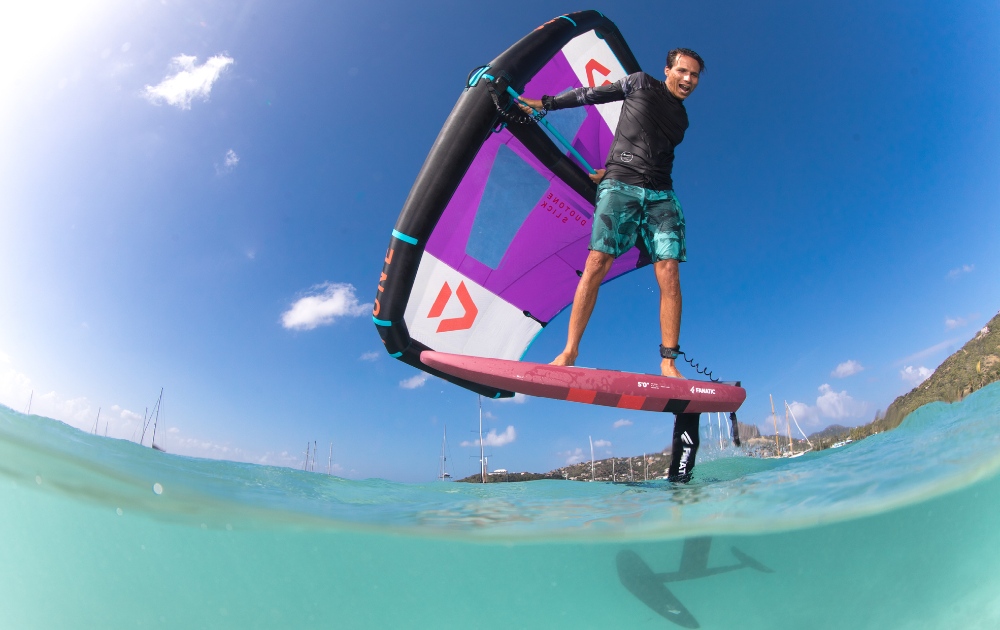
A hydrofoil generates lift the same way a plane’s wing does: move it through water fast enough and it rises. So a wing foiler starts kneeling or standing on what feels like a slightly clumsy floating board, builds speed with the wing — and then, at a certain moment, the foil takes over and lifts board and rider clean out of the water. From there you’re riding on the foil alone, a metre or so up, with almost nothing touching the sea.
The feeling everyone talks about
Your first time up on foil is an incredible feeling, and one that will probably stay with you for the rest of your life. It’s the feeling this whole sport is built on. The drag disappears, the noise stops, everything suddenly goes light, and you are gliding above the water rather than through it. Windsurfers wait years to get something like it from planing, and kitesurfers get their thrills from power and big jumps. With wing foiling the flying is the whole point, and it comes surprisingly early.
A very short history
The idea is older than it looks: a hand-held wing was designed as far back as 1981 — co-created by Jim Drake, the aeronautical engineer who invented windsurfing itself — and a version called the Wind Weapon appeared in the mid-eighties. But without a hydrofoil underneath, a hand-held wing never made sense, and the idea sat dormant for three decades until foils matured. Prototypes were being ridden from the mid-2010s — Slingshot’s Tony Logosz was flying early wing prototypes back in 2015, and riders on Maui proved the combination in 2018 — before the first wings you could actually buy arrived in 2019. The boom began almost immediately.
What’s happened since has surprised even us. In about five years it has gone from a curiosity to just about everywhere: look out across the water at the great wind venues we work with — the Dakhla lagoon in Morocco, Le Morne in Mauritius — and wings now outnumber windsurf sails at most of them. It hasn’t overtaken kitesurfing yet, but it is visibly catching up, and it’s the sport most newcomers to the wind now choose to learn first.
Wing foiling vs kitesurfing vs windsurfing: which should you try?
This is the question we’re asked most, and after 25 years of arranging holidays across all three sports we can answer it without an axe to grind.
| Wing foiling | Kitesurfing | Windsurfing | |
|---|---|---|---|
| Born | 2019 | Late 1990s | Late 1960s |
| The power | Hand-held inflatable wing — no lines, nothing attached | Kite on 20m+ lines | Sail fixed to the board |
| Feels like | Silent flight | Power and big air | Sailing with your body |
| Space needed | Almost none — any water deep enough for the foil | A lot: open beach and clear downwind space | Moderate |
| Beginner safety | Excellent — drop the wing and everything stops | Needs respect — the most powered-up of the three | The gentlest start of all |
| Getting good | Steady — the foil takes a few days, then it clicks | Fast once you’re riding | A long road — the hardest to master |
Windsurfing is the oldest and the safest, and at beginner level it’s honest, easy fun — anyone can potter happily on modern beginner kit within a day, which makes it a lovely holiday sport. The catch comes later: getting genuinely good at windsurfing is a long, demanding road. You either put the years in or you stay a happy dabbler, and there isn’t much in between.
Kitesurfing is the most powered-up of the three and reads as the most extreme. The kite flies on lines over twenty metres long, so you need serious open space, and when things go wrong they go wrong quickly — it’s the sport where mistakes can pick you up off your feet. For many riders that power is exactly the appeal; for others it simply feels like too much. (We’ve written a full guide: what is kitesurfing?)
Wing foiling is the accessible one. No lines, no rigging, nothing attached to you but a leash: let go of the wing and everything simply stops. You don’t need a big beach or a wide-open launch — just water deep enough for the foil’s mast, which opens up lakes, rivers, lagoons and stretches of coast the other sports can’t use. At beginner level it is incredibly safe; the injuries, such as they are, mostly happen at the advanced stage, when riders start jumping. The honest trade-off is that learning comes in two stages, wing first and then foil, and the foil takes a few days of commitment before you’re up and flying.
How you learn — and why it’s taught differently
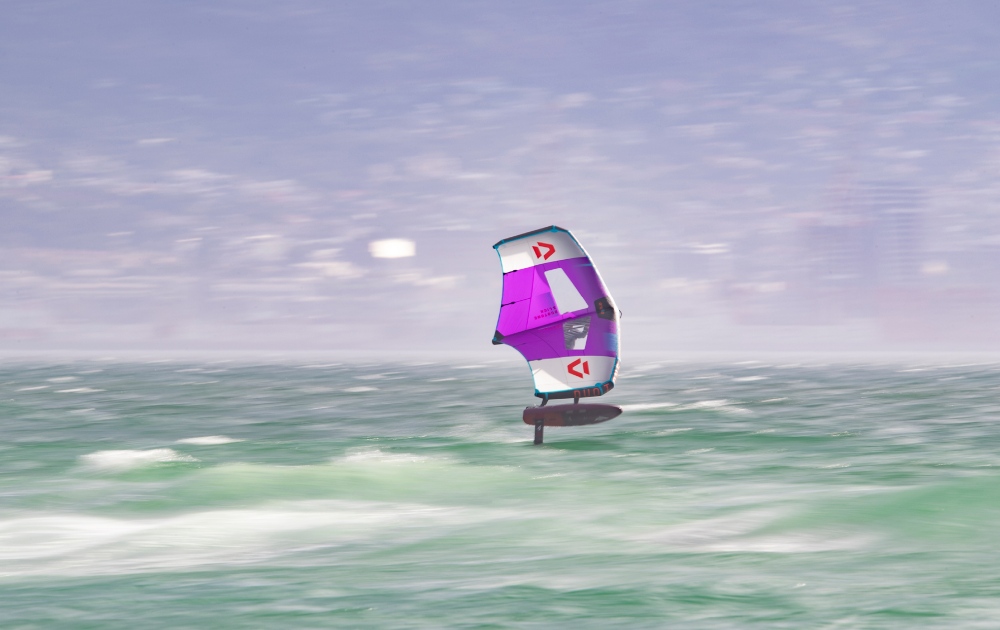
The progression has two distinct stages. First you learn the wing on a big, stable board with the foil kept small or shallow: handling the power, riding off the foil, coming back upwind. Then comes the foil: building speed, feeling for the lift, and learning to control a board that suddenly wants to fly. Touch-downs and splash-downs are part of the deal, and each flight gets a little longer than the last.
Here’s the part most beginners don’t know, and it changes how you should book: wing foiling is the one wind sport where private instruction genuinely matters. A windsurf or kitesurf instructor can stand in waist-deep water beside two or three students all day — when you fall, you stand up next to them. But the foiling stage needs deeper water, and once you’re drifting in it, an instructor can’t walk to you. The schools that teach winging properly follow you one-to-one from a boat or jet ski, coaching as you go. It’s very hard to teach two people at once in deep water, and the difference in progress between boat-supported private tuition and shouted group instruction from the shore is enormous.
The conditions that make it all faster are the same ones we preach for every wind sport, with one addition: flat water, steady medium wind, modern stable equipment — and enough depth for the mast. A metre or so of calm, unobstructed water is the sweet spot: deep enough that the foil never touches down hard, calm enough that you’re learning the sport rather than fighting the sea.
What you need to start
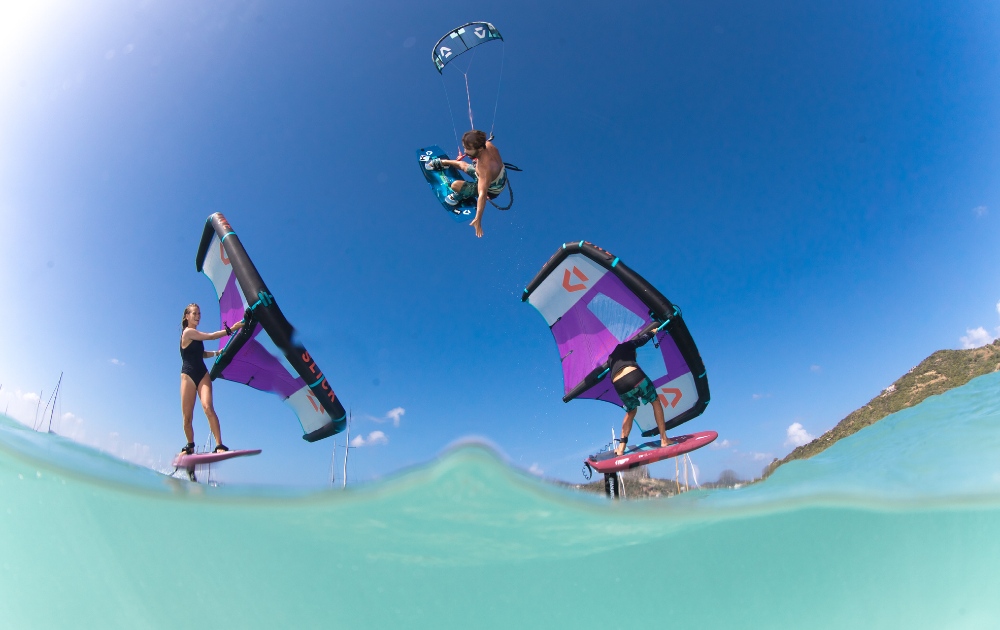
Nothing, at first — learn on a school’s kit. When you do buy, the kit is surprisingly compact: a wing that packs to the size of a sleeping bag, a board, and a foil, all of which fit in one travel bag smaller than any windsurf quiver. Modern beginner boards are big and stable (think 120–160 litres), wings for most adults run four to six square metres, and because the foil is so efficient, wing foiling needs less wind than kitesurfing or windsurfing — 12 to 20 knots is a lovely learning range, and light-wind days that strand the other sports still work on a foil.
Five tips for learning to wing foil
We’ve watched hundreds of clients go through their first week on a wing. It’s the same five things that make the biggest difference every time.
- Wear knee protection — it’s an absolute must. You spend your first sessions kneeling on the board while you get the wing up into the wind, and between the crashes and the climbing back on, bare knees go red raw surprisingly quickly. A cheap pair of neoprene knee pads sorts it out completely.
- Go out in more wind than you think you need. This one surprises everyone. You’d think less wind would be easier, but it’s the opposite: with the wing slightly overpowered you can lean against its pull and use it to steady yourself on the board. Underpowered, you’re trying to balance on a wobbly board while holding a limp wing, which is much harder work.
- Get the flattest water you can find. Even small chop makes learning far harder than it needs to be. Every ripple knocks the board about while you’re still finding your feet, and there’s a reason all the famous learning spots are flat-water lagoons.
- Learn on a nice big, stable board and don’t be in a rush to size down. A big board makes balancing much easier while you’re learning. Most people move onto a smaller board too soon and just make life harder for themselves.
- If you can, dedicate a week to it somewhere with perfect conditions. A run of days with flat water, reliable wind and daily lessons gets you further than months of snatched sessions at home ever will, and you go home able to practise at your local spot with confidence instead of starting from scratch every time.
Where to learn
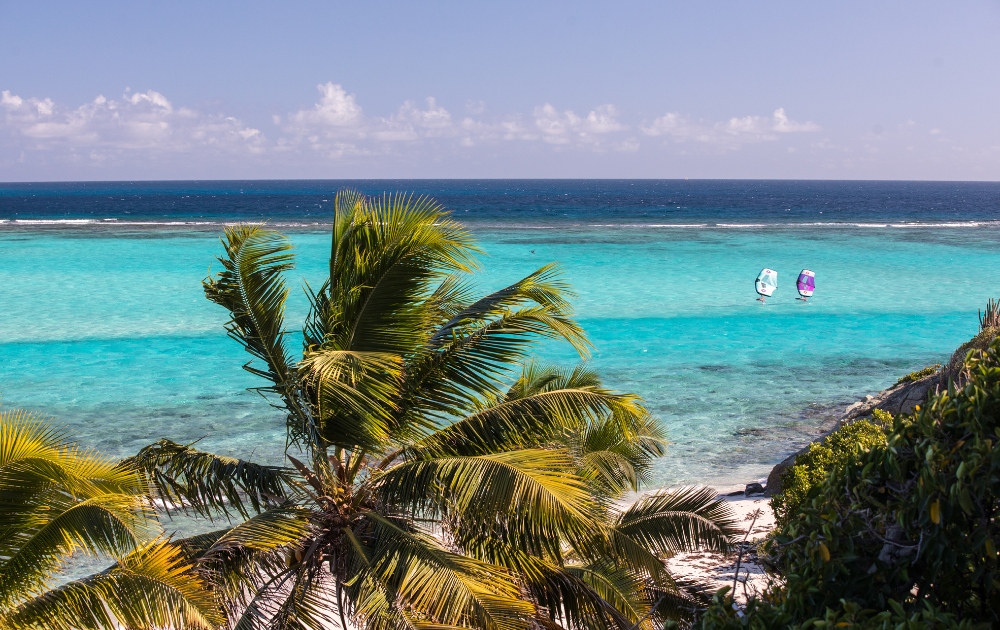
Everything above points the same way: your first week wants a big, flat, uncrowded lagoon with reliable wind and a school that teaches one-to-one with boat support. That combination is much harder to find at home than it sounds, and it’s exactly what the famous wing foiling destinations are known for: the vast flat water of Dakhla, the warm lagoons of Mauritius, and a handful of places like them. Our learn-to-wingfoil holidays are built around exactly these places, and the full collection of wingfoiling holidays covers every level beyond.
Frequently asked questions
Is wing foiling hard to learn?
It comes in two stages. Handling the wing on a stable board is easy — most people manage it in a session or two. Getting up on the foil takes more commitment: typically several days of practice with good instruction, with steady progress and plenty of splash-downs along the way. It sits between windsurfing’s gentle start and kitesurfing’s steep one.
How long does it take to get up on foil?
With one-to-one instruction, flat water and steady wind, most people are experiencing their first controlled flights within three to five days. A background in board sports speeds things up, and patchy conditions slow people down more than anything else.
Is wing foiling dangerous?
At beginner level it’s incredibly safe — there are no lines, and letting go of the wing stops everything instantly. The foil itself deserves respect (it’s rigid and has edges, so you learn to fall away from the board), and injuries mostly come at the advanced stage, when riders start jumping. Learn with a school and the risks at your level are small.
Is wing foiling easier than kitesurfing?
Safer and less intimidating to start, yes — no lines, no big power moments, far less space needed. Kitesurfing progresses faster once you’re riding; wing foiling asks more patience for the foil stage and then delivers a sensation kitesurfing can’t: silent flight. So it’s less that one is easier, more that they reward you in different ways.
Do I need lessons, and should they be private?
Yes, and for wing foiling specifically, private matters. The foiling stage happens in deep water where an instructor can’t stand beside you — the good schools coach you one-to-one from a boat or jet ski. It’s the one wind sport where private lessons are worth every penny: they can halve the learning time.
How much wind do you need?
Less than any other wind sport — the foil is that efficient. Around 12 to 20 knots is ideal for learning, and experienced riders fly in conditions that would leave kites and windsurf sails on the beach.
Where is the best place to learn to wing foil?
A big, flat, reliable-wind lagoon with a school offering boat-supported private instruction — Dakhla in Morocco and the lagoons of Mauritius are the reference examples. A week in one of them replaces a season of scrappy sessions at home.
Ready to fly?
Tell us your dates, your experience on the water so far, and who’s travelling with you, and we’ll recommend the two or three learning spots that suit you best — with a school that teaches one-to-one, the right hotel, and the flights arranged as one booking.
See our learn-to-wingfoil holidays or call +44 1273 921 001.
Free, with no obligation and no booking fee. We’re a UK tour operator with more than 25 years arranging wind-sport holidays. Mon–Fri, 09:00–18:00 UK · 5★ on Google from 190+ reviews · ATOL protected (T7314) and Travel Trust Association members.